
Developed by Dr. Melvin
He discovered these 12 elements after 10 years of his ministry,
so call it 12 foundation blocks, and put it on how to resist failure of ministry.
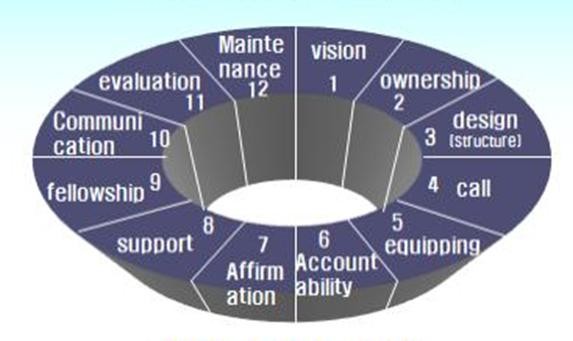
 Dr. Melvin wrote Twelve Foundational Blocks to resist the failure of ministry, but I put the name on it, NORTH STAR because it guided my ministry all the way, nearly for twenty years. Twelve foundations are excellent for any ministry to start up and also for the next few years. How important it is! It was really helpful when I started this ministry, because it was my guideline and just like the North Star for my destination.
After ten years of ministry, LPMI USA, Dr. Melvin himself discovered and wrote these twelve elements. Through ministry he thought about how they succeed in this ministry, or how to resist the failure, so he developed this. Once I started this ministry in 1999, since he has already done 20 years of this ministry in the States, he had plenty of experiences in terms of success or failure of the ministry. I have followed this guidance from the very beginning but now I suggest this to the Melvin students.
It starts with Vision, and finishes with Maintenance. Why? Vision is to startup, and Maintenance is important for keeping nicely what we have. Between two, there are ten elements to complete that puzzle. That is beginning to the end. For me, it took 6 years to master this progress and settled for our ministry. So every ministry needs this element at least 2-4 years in the beginning stage, later on it will come to you automatically as I have done.
Most of other materials generally may use for 1-2 years or 3-4 years, I mean all of written materials of ministry program have focused on the only how to startup, and doing next few years. I found nearly every book has been written about startups, because I think most ministries start and die soon, so the materials for longevity are not good for selling and not many people are interested in those things. No user, no production! So start too soon and die too soon, because they don’t know how to proceed and don’t know what’s in the progress, but our respected Dr. Melvin suggested those necessary elements.
Let’s take a look one by one. The first element is
1. VISION. We have to start at some point, starting line, what is it? We need to get something in our mind which is important for church, for society, or for the people, even for the world. That is the starting point and moment the vision sprung up. For me the vision came to my mind once I was teaching at theological school around 1995 when I came back to Korea from Canada. Then I was asked by the home seminary to teach on Pastoral Care (actually it was my major in those days), so I have eventually discovered Dr. Melvin’s first book, Can the Pastor Do It Alone? (copyright 1987) I taught senior students with the book, and finally they asked me to translate it into Korean. I still vividly remember the moment that I had a strong feeling something compelling in my mind. I think I had a vision at that moment. For Melvin, he got some unsatisfied feeling about not equipping his congregation, even three churches he pastored, so he stopped and thought again over again, it was his visioning moment, we need those moments in even different formats individually, so strong vision is crucial to start up.
The next one is
2. OWNERSHIP. Melvin advised me, literally influenced me to get ownership. I think there were a few things for me to get ownership of in the ministry. Above all I got vision from myself, means from my inside, and then LPMI USA, Dr. Melvin sent me the kind of “Certificate of Appointments” as national director. It means another shot to get more ownership. Even though it is only one page of A/4 size paper, it gave me huge responsibility for the next many years. And then, I got more and more stronger on ownership because local churches kept on asking me very much, so sometimes I have visited three churches and equipped them in a week, through that training I got more ownership, so I became committed my whole of my life for this ministry.
3. STRUCTURE. It should be simple, and it is there just for ministry itself. Sometimes too many people are involved and too complicated a structure, even in the beginning stage. It makes it more difficult to go forward, so to have more people is more complicated, but is okay much later on, but in the beginning we have to be careful not to be too complicated and also not to be distracted. If there are so many people involved in the startup, more trouble will arise. So make simple, just like Jesus, less than 12, I am saying 8 to 10 people is reasonable. Startup is important. For instance when we, I and Pastor Ogillah, started Melvin University in Oyugis, just two of us talked in the beginning stage, and I told him many times that we have to startup first, so just you and me decide and startup, and later on no problem how many people involved in there, but in the beginning, so finally we made it and succeed to startup.
4. CALL, and the fifth is 5. EQUIPPING.
We, as a leader of the ministry, have responsibility to equip them once we startup and later on continuing equipping. There are several equipping opportunities, not just only equipping at church inside, but we can take them to visit other churches that are doing well, and also take them to participate in the regional conference and national conference. This is all the opportunities that they can grow. Actually one LPM/PACE church visited other LPM churches that have done more years already than themselves, so there two teams of lay pastors met together, shared their experiences with each other, and of course I was there so I found it was really helpful for both churches and also both lay pastors. And also attending a national conference is very helpful. I have attended an International conference in the States almost every time since 2,000 because I have equipped myself with many things from there, so we, LPM Korea, have held five conferences in the last fifteen years so lay pastors from all of the churches came and were re-equipped again.
Sixth is 6. COMMUNICATION. There are others: 7. ACCOUNTABILITY; 8. AFFIRMATION; 9. SUPPORT; 10. FELLOWSHIP.
All of them are important but I want to talk about 10. Communication. I was thinking a lot about this. When I started this ministry Dr. Melvin advised me to make a Monthly Newsletter which is only one page of A/4 size. I followed his advice and for the next ten years I made it, but not only monthly, I made weekly, and quarterly two pages, sometimes four pages and even eight pages regularly. In the beginning I made it, but later on I realized the Newsletter led me and our ministry, because people were waiting the newsletter so I have to make it, and I need some story to put into there so I had to work continually, eventually Newsletter led our ministry continually, so I really appreciate to Melvin advised me those practical and also precious advice. So I gave the same advice to other countries as well. They understood what that meant and they published it regularly.
Eleventh is 11. EVALUATION, and the last one, 12. MAINTENANCE.
This is the second most important among those twelve elements. When I taught them I was telling them all the time. The most important element is the first Vision which makes us start, and this last one, Maintenance makes us to go continually, this is not a big thing but even small things, it’s very important because without maintenance our ministry dies.
Maintenance is just like airplane which is flying to the destination, so maintenance make the airplane’s arrival safely at final spot, but most of people are not think it seriously because it looks tiny things and daily job and also routine which is doing same things almost every day, even every hour. But it is important. Just like marriage life is far different from a wedding march. Wedding March takes only for half an hour, or longer one is usually about an hour but marriage life is next 20-30 years, or forever, so it is more difficult to keep up our ministry for the next 30 years continually, just like that. Maintenance is important. I taught this to the people, lay people. pastor’s group, and at seminaries overseas, and then they were so impressed by my teaching.
Rev. Byeong
LPM Korea
